

Self-Hosted AI vs Cloud APIs: What South African Businesses Need to Know
You’re burning R50k per month on OpenAI calls. There’s an alternative that gives you control, cuts costs, and keeps your data in South Africa.
Let me start with a number that should make you uncomfortable: R50,000 per month. That’s what a mid-size South African SaaS company I consulted with was spending on OpenAI API calls for their document processing pipeline. No fine-tuning. No customization. Just feeding customer data into a black box and hoping the invoices kept coming.
The worst part? When they asked OpenAI what model they were using on any given request, the answer was essentially “it depends.” When they asked about data residency, the answer was vague. When the rand dropped 8% against the dollar in a single week, their AI costs jumped by R4,000 overnight — with zero change in usage.
Self-hosted AI isn’t for everyone. But for the right use cases, it’s 10x cheaper and gives you control that cloud APIs never will. Here’s the breakdown.
TL;DR: Which Approach Is Right for You?
Before we dive into the numbers, here’s a quick decision matrix based on business type and priorities:
| Business Type | Recommended Approach | Why |
|---|---|---|
| Startup MVP / Proof of Concept | Cloud APIs | Speed to market matters more than cost at this stage. Validate first, optimise later. |
| Law Firm / Healthcare | Self-hosted or Hybrid | Data sovereignty isn’t optional. POPIA compliance and client confidentiality demand local inference. |
| University / Research | Self-hosted | High-volume workloads, existing GPU labs, educational use cases. Cost savings compound quickly. |
| Internal Support Desk | Self-hosted | High call volume, sensitive internal data, predictable workload. Classic self-host win. |
| Public SaaS Platform | Cloud-first, Hybrid over time | Start with cloud for flexibility. Migrate high-volume workloads to self-hosted as usage grows. |
| Financial Services / Fintech | Self-hosted | FSCA regulations, transaction data, customer PII — none of it should leave your infrastructure. |
| Retail / E-commerce | Hybrid | Customer support AI self-hosted, recommendation engines can stay cloud. Mix based on sensitivity. |
Cost Scenario Comparison
The right choice depends on your volume, sensitivity, and team capabilities. Here’s how the numbers play out across common scenarios:
| Scenario | Cloud API (Monthly) | Self-Hosted (Monthly) | Verdict |
|---|---|---|---|
| 5 users, light usage | R500 – R2,000 | R6,000+ (infra overkill) | Cloud — not worth the infra |
| 50 staff internal chatbot | R15,000 – R40,000 | R6,000 – R10,000 | Self-hosted — cost wins at scale |
| 10k documents/day processing | R83,000+ | R6,000 | Self-hosted — 14x cheaper |
| POPIA-sensitive legal docs | Risk of non-compliance | R6,000 – R15,000 | Self-hosted — compliance is non-negotiable |
| Offline branch office | Cannot function | R6,000 – R10,000 | Self-hosted — only viable option |
| Prototyping / R&D | R2,000 – R5,000 | R6,000+ (premature) | Cloud — iterate fast, decide later |
| Customer support bot (high volume) | R50,000+ | R8,000 – R15,000 | Self-hosted — volume makes it obvious |
The Cost Reality: Cloud APIs vs Self-Hosted Infrastructure
Every comparison article starts with “it depends,” and I’m not going to pretend otherwise. But let me give you actual numbers instead of hand-waving.
Cloud AI pricing looks cheap at small scale. OpenAI’s GPT-5.4 charges roughly $2.50 per million input tokens and $15 per million output tokens. Anthropic’s Claude Sonnet 4.6 charges around $3 and $15 respectively. At first glance, that’s nothing. But scale matters.
Consider a document processing workflow that handles 10,000 documents per day, each averaging 3,000 tokens input and 500 tokens output. That’s 30 million input tokens and 5 million output tokens daily. At GPT-5.4 pricing, that’s roughly $75 per day in input costs alone, plus $75 in output. Call it $150 per day or R83,000+ per month at current exchange rates (R18.50/USD).
Now compare that to self-hosting. A single NVIDIA RTX 4090 can run Llama 3.1 8B or Mistral 7B at respectable throughput. The card costs around R48,000 to R52,000 once-off at current retail prices — AI demand has pushed stock prices up. Electricity in South Africa at R4.00 per kWh (the 2026 NERSA baseline for metro areas), running 24/7 at 450W, costs about R1,300 per month. Add in the server hardware — a decent workstation or rack server — and you’re looking at maybe R5,000 to R6,000 per month in total operating costs.
| Factor | Cloud API (GPT-5.4) | Self-Hosted (Llama 3.1 8B) |
|---|---|---|
| Monthly Cost (10k docs/day) | R83,000+ | R6,000 (infra only) |
| Cost Per Token | R0.000046 | R0 (after hardware payback) |
| Hardware Cost | N/A | R48,000 – R52,000 |
| Electricity (SA rates) | N/A | R1,300/month |
| Maintenance Overhead | None | 5-10 hrs/month |
| Data Leaves SA? | Yes — US servers | No — on-premise |
Quick Maths — 10k Documents/Day
Input tokens: 10,000 docs × 3,000 tokens = 30M/day
Output tokens: 10,000 docs × 500 tokens = 5M/day
Cloud API cost:
Input: 30M × $2.50/M = $75/day
Output: 5M × $15/M = $75/day
Total: $150/day
Rand conversion:
$150 × R18.50 = R2,775/day
≈ R83,000/month
Assumptions: GPT-5.4 flagship pricing, R18.50/USD exchange rate, average doc size 3,000 input / 500 output tokens.
Of course, these numbers shift depending on scale. If you’re processing 100 documents a month, cloud APIs are the obvious choice. The break-even point for most self-hosted AI workloads sits somewhere around 5,000 to 10,000 API calls per day, depending on model size and complexity.
The rand-to-dollar exchange rate is a hidden tax on every AI API call. When the rand weakens, your AI budget gets cut — but your workload doesn’t shrink.
And then there’s the load shedding factor. South African businesses can’t rely on grid power for uninterrupted operation. Your self-hosted infrastructure needs UPS backup, generator capacity, or a hosting provider with local data centers that has power redundancy sorted. Factor that into your total cost of ownership.

Control and Data Privacy: What Actually Matters
Cost isn’t the only reason to consider self-hosted AI. For South African businesses in regulated industries, it might be the only viable option.
When you use a cloud AI API, your data transits to and from their servers. For OpenAI, that means US data centers. For most other providers, the same applies. Your customer data, financial records, legal documents, medical records — they all leave South African jurisdiction.
POPIA Compliance
South Africa’s Protection of Personal Information Act (POPIA) places strict requirements on how personal data is processed and stored. While POPIA doesn’t explicitly ban sending data offshore, it requires:
- Informed consent — You must tell users their data goes to US servers
- Adequate protection — The offshore country must have comparable data protection
- Contractual safeguards — Binding agreements with the processor
- Right to object — Users can object to offshore processing
For most companies, this means either a lengthy legal review of every AI provider’s terms of service, or simply keeping the data on-premise. The second option is faster, cheaper, and more defensible in an audit.
Worth noting: South Africa’s Draft National AI Policy (published April 2026) signals that the government intends to fold AI governance directly under Section 71 of POPIA, which specifically handles automated decision-making. Even though the initial draft was withdrawn for revisions, it confirms the regulatory direction: AI systems that make decisions about people will face stricter scrutiny. Self-hosted AI gives you a head start on compliance.
Industries Where Data Sovereignty Is Non-Negotiable
- Financial Services: Banks, insurers, and fintech companies handle sensitive financial data subject to FSCA regulations
- Healthcare: Patient records under the National Health Act cannot be casually exported
- Legal: Attorney-client privilege doesn’t lose its weight because an API call happened
- Government: State organs are bound by strict data classification policies
Model Customisation and Control
Control also means the ability to fine-tune, customise, and adapt. Cloud APIs give you whatever model version they decide to run that day. OpenAI has silently swapped model versions, changed output quality, and introduced new safety layers that affect business-critical outputs — all without opt-out options for API customers.
Self-hosted models are yours. You choose the version. You control the parameters. You can fine-tune on your own data without sharing that data with anyone. When Mistral releases a new model, you evaluate it on your terms and deploy it on your schedule.
Control isn’t about paranoia. It’s about predictability. When your AI output drives business decisions, you need to know exactly what model produced it and why.
There’s also the uptime argument. Cloud APIs have outages. OpenAI has experienced multiple incidents where API availability dropped to single-digit percentages for hours. If your workflow depends on AI processing — document ingestion, customer support bots, real-time analysis — a cloud outage means your business stops. Self-hosted infrastructure, properly configured with redundancy, keeps running.
When Cloud APIs Actually Win
I’ve spent the last thousand words making the case for self-hosting. Now let me be honest about where cloud APIs are the better choice — because pretending otherwise would be dishonest.
Prototyping and Experimentation
When you’re validating a concept, spending weeks on infrastructure setup is counterproductive. Spin up a cloud API, prove the concept, then decide on deployment strategy.
Low-Volume Workloads
If you’re making fewer than 5,000 API calls per day, cloud pricing is almost always cheaper than maintaining your own hardware. Don’t over-engineer a solution to a small problem.
Bleeding-Edge Models
GPT-5.5, Claude Opus 4.7, Gemini Ultra — these models are years ahead of what runs on a single consumer GPU. For tasks requiring frontier intelligence, cloud APIs are the only option.
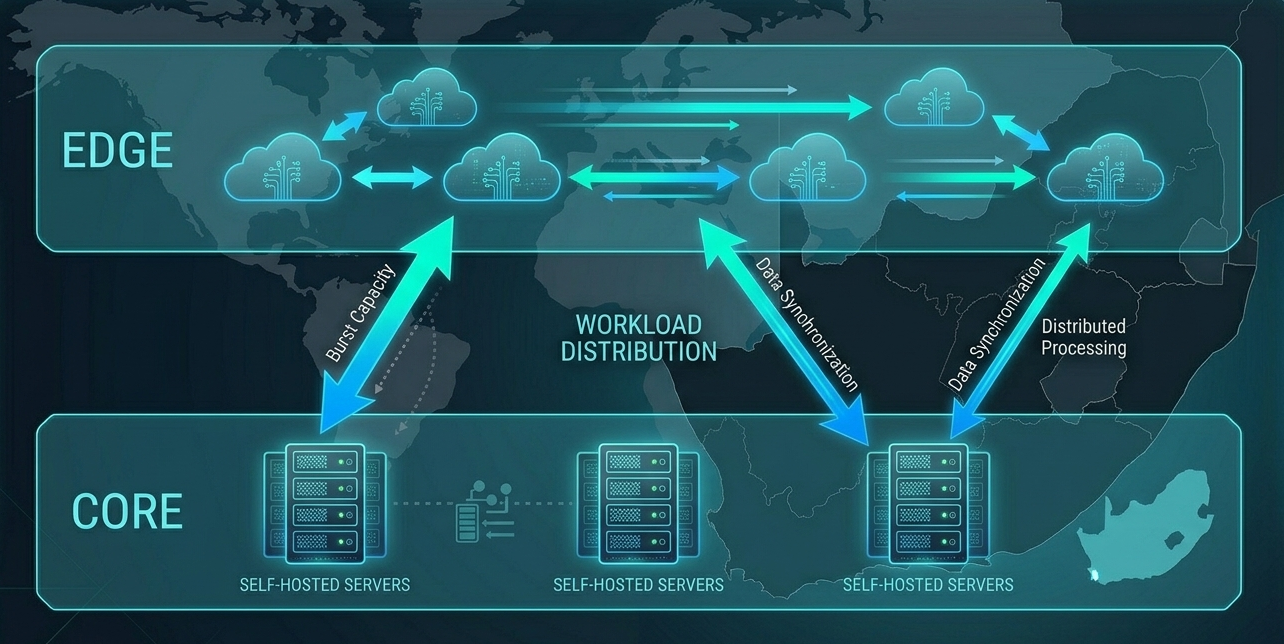
The hybrid approach is where most businesses should land. Self-host your core AI workloads — document processing, customer support, internal search — where volume is high and data sensitivity matters. Use cloud APIs for experimentation, edge cases, and tasks requiring the most capable models available.
This is exactly the architecture we use at NemesisNet. Our AI development services start with a hybrid assessment: what’s your volume, what’s your sensitivity profile, and what models do you actually need? The answer is rarely “all cloud” or “all self-hosted.”
Infrastructure Requirements: What You Actually Need
Self-hosted AI sounds great on paper. But what does it actually take to set up and run? Let me break it down by tier.
Entry-Level: Single Consumer GPU
An NVIDIA RTX 4090 (24GB VRAM) can run models up to 13B parameters comfortably with quantisation. This handles chat and conversational AI workloads, document summarisation and extraction, code generation for internal tools, and text-to-speech engines like Kokoro or Piper.
You’ll need a machine with at least 32GB RAM, a modern CPU, and fast NVMe storage. Total hardware cost: roughly R80,000 to R120,000. Software: Ollama, vLLM, or LM Studio for local serving. Both are free and well-documented.
Infrastructure Cost Breakdown — Entry-Level
Hardware (once-off):
RTX 4090 (24GB VRAM): R48,000 – R52,000
Workstation + 32GB RAM + NVMe: R30,000 – R70,000
Monthly running costs:
Power: 450W × 24h = 10.8 kWh/day
10.8 kWh × R4.00/kWh × 30 days = R1,300/month
Network, cooling, misc: ~R1,700/month
Total: ~R6,000/month
Assumptions: 2026 NERSA metro rate R4.00/kWh, RTX 4090 TDP 450W, 24/7 operation.
