
The framework debate that actually matters when you’re building for production.
What You’ll Learn
-
Learning Curve
Which framework gets new developers productive faster?
-
State Management
Pinia vs Zustand — which handles complex SaaS state better?
-
Hiring in South Africa
Which framework has the deeper talent pool locally?
-
Honest Verdict
When to choose Vue, when to choose React — no fanboyism.
The Problem with Framework Comparisons
Most framework comparison articles are useless. They compare hello-world apps, benchmark rendering loops nobody hits in production, and conclude with “it depends.” That’s not helpful when you’re a CTO choosing a framework for a multi-tenant SaaS that needs to scale, hire for, and maintain for the next 5 years.
This article compares Vue 3 and React through the lens of building enterprise SaaS applications — the kind with complex state management, multi-user permissions, real-time updates, PDF generation, and deployment pipelines that need to work at 2am when you’re the only one on call.
We’ve built production SaaS with both. Here’s what actually matters.
What We’re Comparing
| Criteria | Why It Matters |
|---|---|
| Learning curve | How fast can a new hire become productive? |
| TypeScript support | Type safety catches bugs before production |
| State management | SaaS apps have complex, interconnected state |
| Component architecture | Reusability across a large codebase |
| Ecosystem & libraries | Auth, forms, tables, PDF generation, testing |
| Performance | Bundle size, render performance, SSR options |
| Hiring & talent pool | Can you find developers in South Africa? |
| Long-term maintenance | Breaking changes, migration pain, community direction |
Learning Curve
Vue 3
Vue’s learning curve is gentler. The Options API was already beginner-friendly, and the Composition API (Vue 3’s answer to React hooks) is optional — you can adopt it incrementally. A junior developer can be productive in Vue within a week.
The template syntax feels natural if you come from an HTML background. Directives like v-for, v-if, and v-model are intuitive. The single-file component (SFC) structure keeps template, logic, and styles co-located without needing a build tool to understand what’s happening.
React
React’s learning curve is steeper, but the ceiling is higher. JSX feels weird at first — mixing HTML-like syntax with JavaScript expressions. But once it clicks, it’s powerful. Everything is JavaScript. No template language to learn, no special directives to memorize.
React hooks changed everything. useState, useEffect, useContext — once you understand the mental model, you can build anything. But the mental model is less obvious than Vue’s reactivity system.
Verdict: Vue Wins
Vue wins for onboarding. New developers productive faster. React wins for developers who want full control over every aspect of the component.
TypeScript Support
Vue 3
Vue 3 was rewritten in TypeScript. The core team uses it. The official docs are bilingual (JavaScript + TypeScript). Type inference in <script setup> is excellent — you get autocompletion and type checking without explicit type annotations in most cases.
The weak spot: template type checking. Vue’s template compiler doesn’t fully validate template expressions against TypeScript types at build time. You need vue-tsc for that, and it’s slower than tsc.
React
React’s TypeScript support is mature and battle-tested. The DefinitelyTyped @types/react package is comprehensive. Every hook, every prop, every context — fully typed.
TSX (TypeScript + JSX) works seamlessly. The type system catches prop mismatches, event handler errors, and generic type issues at compile time. It’s not perfect — hooks have some type inference quirks — but it’s the gold standard for TypeScript in frontend frameworks.
Verdict: React Wins
React wins for TypeScript. More mature type definitions, better template/JSX type checking, and a larger ecosystem of typed libraries.
State Management
Vue 3
Vue’s reactivity system is built into the language. ref() and reactive() make state management feel magical. Changes to reactive objects automatically update the DOM — no selectors, no dispatchers, no boilerplate.
For simple to moderate state: Pinia (Vue’s official state manager) is clean, typed, and minimal. It’s what Redux wishes it was. For complex state: composables (Vue’s custom hooks) let you encapsulate reusable state logic without the ceremony of Redux middleware.
// Pinia store — clean, typed, minimal
export const useJobStore = defineStore('jobs', () => {
  const jobs = ref<Job[]>([])
  const loading = ref(false)

  async function fetchJobs() {
    loading.value = true
    jobs.value = await db.getList('jobs', {
      expand: 'customer_id,vehicle_id'
    })
    loading.value = false
  }

  return { jobs, loading, fetchJobs }
})
React
React’s state management is more fragmented. useState for local state. useReducer for complex local state. useContext for global state (with performance caveats). Then there’s Redux, Zustand, Jotai, Recoil, MobX — the ecosystem is rich but overwhelming.
For production SaaS, Zustand has emerged as the pragmatic choice: minimal boilerplate, no providers, TypeScript-first.
// Zustand store — minimal, no providers
interface JobStore {
  jobs: Job[]
  loading: boolean
  fetchJobs: () => Promise<void>
}

export const useJobStore = create<JobStore>((set) => ({
  jobs: [],
  loading: false,
  fetchJobs: async () => {
    set({ loading: true })
    const jobs = await db.getList('jobs', {
      expand: 'customer_id,vehicle_id'
    })
    set({ jobs, loading: false })
  }
}))
Verdict: Vue Wins
Vue wins for simplicity. Reactivity is built-in, not bolted on. React has more options but more decisions to make. For a team that wants one clear way to do state management, Vue + Pinia is the answer.
Component Architecture
Vue 3
Vue’s single-file components (SFCs) are the cleanest component model in frontend frameworks. Template, script, and style in one file. No CSS-in-JS overhead. No className strings. Just <style scoped> and you’re done.
<script setup lang="ts">
// Composable — reusable logic, no dependency array headaches
const { jobs, loading, fetchJobs } = useJobs()
</script>

<template>
  <div v-if="loading">Loading...</div>
  <JobList v-else :jobs="jobs" />
</template>

<style scoped>
/* Scoped styles — no CSS leakage */
.loading { opacity: 0.6; }
</style>
React
React components are more flexible but less structured. You can use class components (legacy), function components (modern), render props (deprecated), HOCs (legacy), or hooks (current). The flexibility is a double-edged sword.
CSS management is a pain point. CSS Modules, styled-components, Tailwind, vanilla CSS — too many choices. Tailwind has become the de facto standard, but it means every component needs className strings instead of clean template syntax.
Verdict: Vue Wins
Vue wins for structure. SFCs + scoped styles + composables give you a clean, opinionated component model. React gives you freedom, but freedom means more decisions and more inconsistency across a team.
Ecosystem & Libraries
Form Libraries
| Library | Vue | React | Notes |
|---|---|---|---|
| React Hook Form | No | Yes | Best-in-class for React |
| VeeValidate | Yes | No | Solid Vue form validation |
| FormKit | Yes | No | Vue-native, full-featured |
| Formik | Yes | Yes | Works in both, showing its age |
React wins. React Hook Form is faster, lighter, and better maintained than anything in the Vue ecosystem.
Table Libraries
| Library | Vue | React | Notes |
|---|---|---|---|
| TanStack Table | Yes | Yes | Headless, framework-agnostic |
| Vuetify Data Table | Yes | No | Vue-specific, opinionated |
| AG Grid | Yes | Yes | Enterprise-grade, feature-rich |
Tie. TanStack Table works great in both. AG Grid is the enterprise choice if you need sorting, filtering, grouping, and pivoting out of the box.
PDF Generation
| Library | Vue | React | Notes |
|---|---|---|---|
| @react-pdf/renderer | No | Yes | React components → PDF |
| PDFMake | Yes | Yes | Framework-agnostic |
| jsPDF | Yes | Yes | Low-level, manual layout |
React wins. @react-pdf/renderer is the best PDF generation library in any ecosystem. React components that render to PDF — it’s brilliant.
Verdict: React Wins Overall
React wins overall. More libraries, better maintained, more enterprise-grade options. Vue’s ecosystem is catching up but React’s head start shows.
Performance
Bundle Size
Vue 3’s runtime is ~33KB gzipped. React + ReactDOM is ~42KB gzipped. Vue’s tree-shaking is excellent — you only ship what you use.
In practice, bundle size doesn’t matter as much as people think. Both frameworks lazy-load well. Code splitting works in both. The difference is negligible for most SaaS applications.
Runtime Performance
Both frameworks are fast enough for any SaaS UI. Vue’s reactivity system is slightly more efficient for granular updates (it tracks dependencies at the property level). React re-renders entire component subtrees by default, which is mitigated by React.memo and useMemo but requires developer discipline.
SSR / SSG
React wins here. Next.js is the gold standard for SSR/SSG. Nuxt (Vue’s SSR framework) is solid but less mature. If you need server-side rendering for SEO or performance, React + Next.js is the safer choice.
Verdict: Tie for SaaS
Tie for SaaS. Both are fast enough. Vue is slightly more efficient by default. React has better SSR options. For a typical SaaS dashboard, performance is not a differentiator.
Hiring & Talent Pool (South Africa)
This is where it gets real.
React
React developers are everywhere. Every bootcamp teaches React. Every job board has React positions. In South Africa, React is the dominant frontend framework. If you post a React position, you’ll get 50+ applications.
The talent pool is deep but shallow — lots of junior React developers, fewer senior ones. Everyone knows React, but not everyone knows it well.
Vue
Vue developers are harder to find. The framework is popular in Asia and Europe but less dominant in South Africa. If you post a Vue position, you’ll get fewer applications — but the applicants tend to be more experienced.
Vue developers often come from PHP/Laravel backgrounds (Vue is Laravel’s default frontend framework). This can be an advantage if your backend is PHP-based.
Verdict: React Wins for Hiring
React wins for hiring. More developers available, easier to scale a team. Vue wins for developer quality — the smaller pool self-selects for more experienced developers.
Long-Term Maintenance
Breaking Changes
Vue’s migration path is smoother. Vue 2 → Vue 3 was painful (Options API → Composition API), but Vue 3 has been stable since 2020. The Composition API is optional — you can keep using Options API indefinitely.
React’s breaking changes are more disruptive. Class components → hooks was a paradigm shift. React 18’s concurrent features changed how you think about rendering. React 19 is introducing new patterns. Each major version feels like a new framework.
Codebase Size
Vue SFCs tend to produce smaller, more focused components. The template/script/style separation encourages clean boundaries.
React components can grow unwieldy. Without the structural constraint of SFCs, it’s easy to create god components that do too much. This requires team discipline and code review culture.
Verdict: Vue Wins
Vue wins for maintenance. More stable API, smoother migrations, cleaner component boundaries. React’s innovation velocity is a double-edged sword — you get new features but more churn.
The Verdict
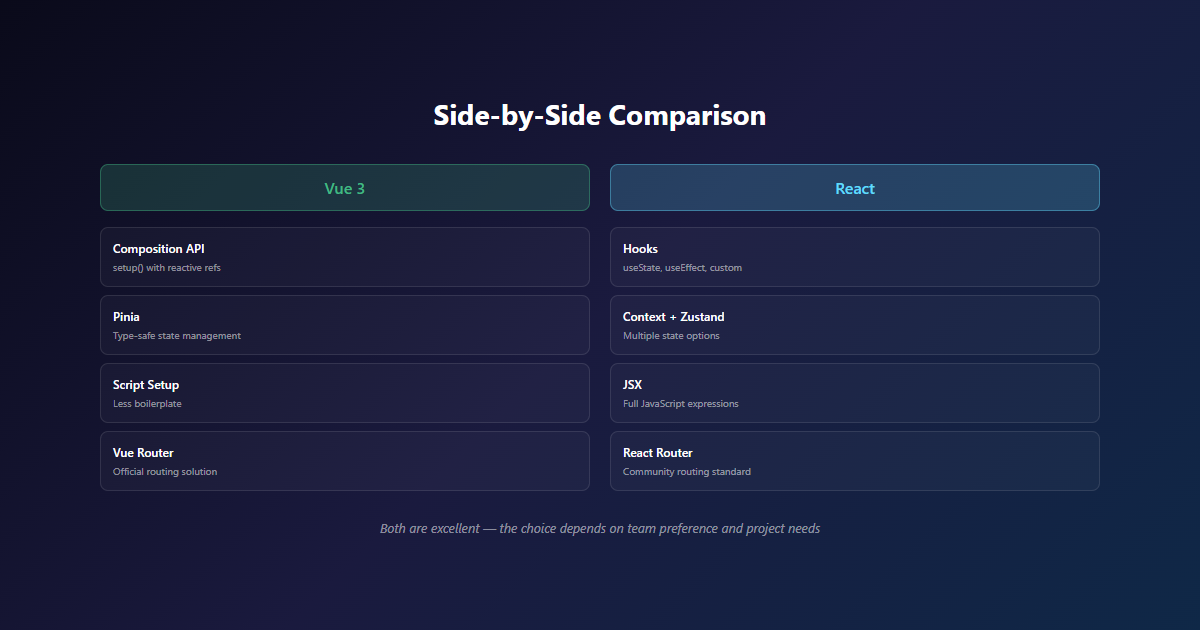
Choose Vue 3 if:
- Your team is small (2-5 developers)
- You want faster onboarding for new hires
- You value convention over configuration
- Your backend is Laravel/PHP
- You’re building a focused SaaS with moderate complexity
- You want less boilerplate and more productivity
Choose React if:
- Your team is larger (5+ developers)
- You need the largest possible talent pool
- You want the best TypeScript support
- You need SSR/SSG (Next.js)
- You’re building a complex UI with many third-party integrations
- You want the widest library ecosystem
Our Take
For enterprise SaaS in South Africa, we’d lean Vue 3 for most projects. Here’s why:
- Faster development — Vue’s reactivity and SFCs mean less code, fewer bugs, faster iterations
- Easier maintenance — Stable API, clean component boundaries, less churn
- Better DX — Vue’s tooling (Volar, devtools) is excellent
- Laravel integration — If your backend is PHP, Vue is the natural choice
But we’d choose React for:
- Complex UIs — Large dashboards with many interactive elements
- SSR requirements — Next.js is unbeatable for server-rendered content
- Large teams — React’s flexibility scales better with more developers
- Library dependencies — When you need specific React-only libraries (like @react-pdf/renderer)
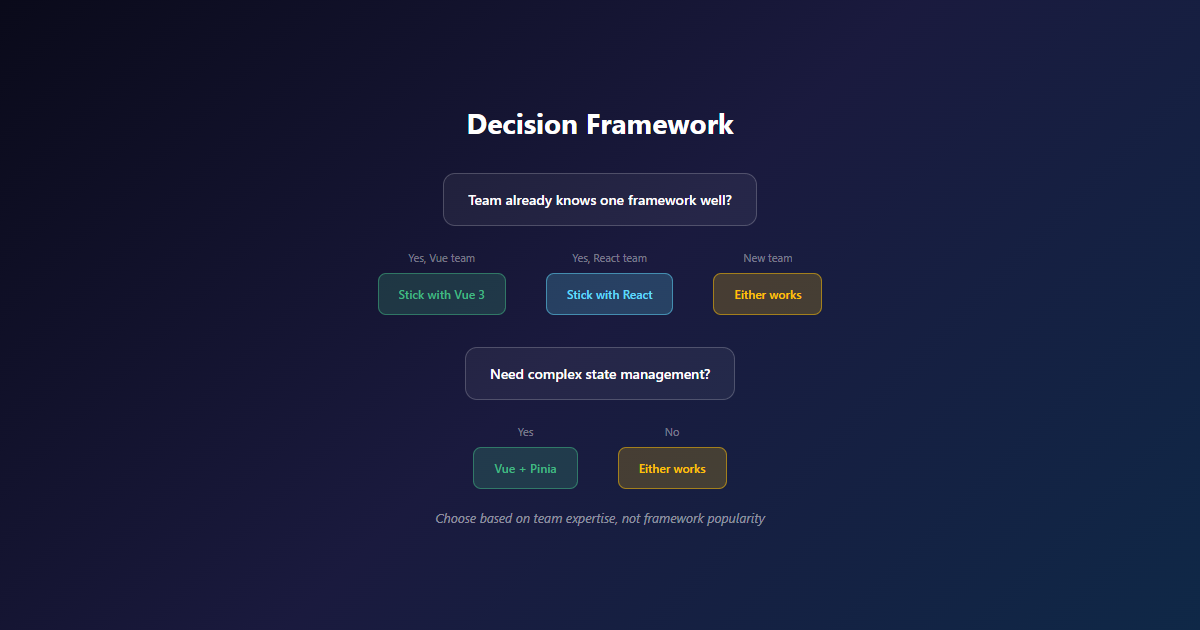
The honest answer: both frameworks are production-ready for enterprise SaaS. The difference is in developer experience, team composition, and specific requirements — not in capability.
Decision Flowchart
What We’ve Built
| Project | Framework | Why |
|---|---|---|
| TorqueBooks | React 19 | PDF generation, large component tree |
| ForkMyFolio | Spring Boot + React | Enterprise architecture, complex state |
| NemesisNet Blog | WordPress | Not SPA — not applicable |
Both frameworks served us well. The choice depends on the project, not the framework.
Need Help Choosing?
We’ve built production SaaS with both Vue and React. Whether you’re starting a new project or evaluating your current stack, our team can help you make the right choice for your specific needs.
Related Reading
- TorqueBooks Build Story — React 19 in production with PocketBase
- Runtime Env Injection — Docker deployment patterns for any frontend framework
- SaaS Development — Vue and React SaaS platforms for South African businesses
- Custom Software Development — Full-stack development with modern frameworks
